

 The beautiful table (shown above after treatment by MPFC) was made for the Crater Lake National Park by members of the Civilian Conservation Corps, or CCC. Several pieces of furniture were made for the parks, such as the bench we also conserved, shown right; unfortunately not all of them have survived.
CCC HISTORY
 The CCC was created by President Franklin Roosevelt to offer manual labor jobs to young men between the ages of 17-28 during the Great Depression. The CCC both trained the men and benefited from the work program, which ran from 1933 to 1942 and employed over three million men.
“I propose to create [the CCC] to be used in complex work, not interfering with normal employment and confining itself to forestry, the prevention of soil erosion, flood control, and similar projects. I call your attention to the fact that this type of work is of definite, practical value, not only through the prevention of great present financial loss but also as a means of creating future national wealth,” President Roosevelt, 21 March 1933.
Left, this image is a work of a Works Progress Administration employee (Albert M. Bender),
taken or made as part of that person’s official duties. As a work of the U.S. federal government,
the image is in the public domain (17 U.S.C. §§ 101 and 105).
For more information (and our sources for info):
- Wiki: Civilian Conservation Corps
- Records of the Civilian Conservation Corps [CCC]
- National Archives Catalogue
- RG79 – Records of the National Park Service
- and because it is interesting, the She-She-She Camps (for women).


Note 1: Excuse some of the poor images, examples above in our “BEFORE” and “AFTER” images.
Our first digital cameras were in use in these images in 2008-2014. Between getting to know
how the cameras worked, and their own poor imagery on occasion, the early images were
hard to edit in Photoshop as opposed to modern images, especially when there were
high contrast light and dark areas in the same image.
Note 2: It was during this time we moved to Portland and found our studio rooms. Unfortunately, we
had to wait until two people moved out to inhabit all that we needed, but they were scheduled to move. Understand this is why so many moving boxes are stacked all around and under our worktables!

ASSESSMENT


When we first met the large Myrtle wood CCC table it was buried in the historian’s office at Crater Lake where he used it for his desk, above. Our assessment was taken around stacks of folders piled on top of and under the table, and we could not photograph much more than we are showing you in the images above.
Messy, yes, but thankfully it had been secreted away in his office where it received gentle use, because it was protected from what would eventually have been a nearly irreparable break in the hands of park visitors!
STRUCTURE
 The thick myrtle wood boards that made up the table were warped and cracking in several places, shown right in the image of Mitchell sitting on the edge of the table to demonstrate. As an example, had this one area been left to be used by visitors, it would have likely cracked clear through. The boards are not all the same width: the two edge boards are 6.25″ wide, while the three center planks are 8.5″ wide.
At the time, the management at the NPS had not made up their minds on what would happen with the table when it returned. It might live in the curatorial offices as a conference and work table for visitors, or might be used again with supervision. This is one of the protocols of the National Parks, that history is sometimes used daily rather being set aside in a museum.
 OUR PROPOSAL
MPFC proposed to create two additions to the CCC table.
- The first would hold up the boards on the tables long edges, where the likelihood of further damage was high if the tables were to go back into use.
- We also wanted to secure the warping boards so they did not continue to twist.
- We wanted the additions to look like they part of the original design, and yet they would be removable if necessary.
TABLE SURFACE


 The table surface had cracks, splitting boards, and areas where it appeared that someone had carved out a square and driven a peg into the table, such as shown right, and for that we have no good reason to offer.
Over the years when it was used for crafts or as a work table, blue and white oil-based paint was splattered all over it.
 The surface had interesting “natural” anomalies:
- Bark was left on one of the corner boards, shown left,
- Knots were left in the boards, shown bottom right.
This only added to the rustic appearance and tells us a bit about the makers of the table.
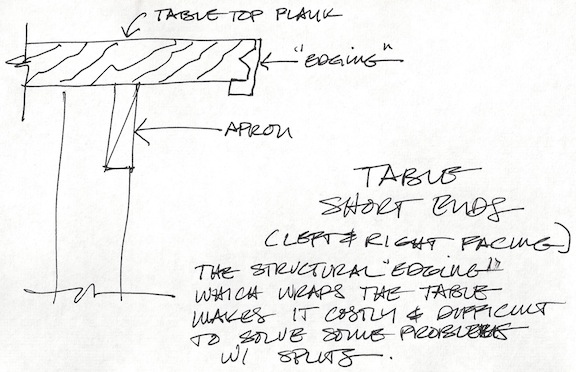 The edging helped hold the table together when it wanted to split, as shown below in image two. In order to repair some of the largest splits in the tabletop, we would have to remove the rabbeted edging, and we thought this was a very invasive procedure which might damage the edging, therefore, on the largest tabletop splits we proposed to insert butterfly keylocks in order to stop the splits from growing..
Some of the splits measured in at over a quarter-inch, shown below in the first image.
As you will see, there were other small repairs to be done to the structure of the table in order to stabilize the top and legs.


FINISH
Finally, the legs and top needed to be cleaned and finished as part of its preservation protocol, to bring it back to a proper representation of a historic antique which had been kept in good working condition.
REPARATION

Above, the table before treatment in what became our new finish room!
CARVED BLOCKS + STRETCHERS
 Besides keeping the long edge tabletop boards from splitting, we also wanted to give the center boards some additional stability.
To that end, we created a system of carved blocks and stretchers (the latter shown on either side of the historic stretcher), as shown after reparation and finish treatment, right (because a picture is worth a thousand words).
The table was turned upside down during treatment, above, and that is the position it lived for all but the final cleaning and finish to the tabletop and legs.


 2×6 clear vertical grain fir with a tangential grain face were used for the stretchers.
2×6 iroko boards were used for the carving blocks, shown above right. Iroko wood, left, looks very similar to the rusty-colored aged Myrtlewood, and yet it is hard and durable.
Both sets of 2×6 boards were glued together using hide glue, and clamped to cure, shown above.
 STRETCHERS
Once cured, the fir was cut into the stretcher lengths needed: four long and four short, shown left.
Two long stretchers would supplement each end, which was left unsupported, shown below. Two short stretchers wrapped each side of the center leg post, shown below.


Above, the long and short stretchers shown after both reparation and finish treatment.
CARVING BLOCKS


 Carving blocks were created from iroko boards, laid together and glued using hide glues, then allowed to cure, not shown.
Proper sized blocks were cut, above left and right.
 The placement of the blocks was laid out in chalk, and we realized that on some blocks an additional bit of iroko needed to be added; on historic items there are often anomalies in size, and as the CCC table was hand-made, this is not surprising.
The rough shape of the carving block was readied and fit to the final place in each spot on the historic table.
We decided to carve a motif similar to the trees used on the legs.


Kate drew a carving pattern on each block, shown above.


 Mitchell began hand-carving the images on the hard iroku.
Once they were basically carved, we added our own design touches to the stabilizing blocks, by taking the edges off at an angle. This also meant they did not hurt anyone who might bump into them while using the table.


Finally, the blocks were hand-sanded to further soften the edges, and remaining pencil marks were removed.
LARGE CRACKS
Large cracks were treated in two ways depending upon their depth and location.


MINOR LEG CRACK
 While unsightly, this crack is not a danger to the structure. However, it can be infested with pests if not filled, and to that end needed reparation.
It was filled with a repair paste we created from carnuaba, tree resins (damar, sandarac, copal, and mastic) infused in larch balsam, finely ground earth pigments, and tung oil. It is a wonderful paste and lasts for years. Though it is a very hard paste, it can be burnished. Its melting point is 180-degrees, so it can also withstand sunlight.


 STRUCTURAL SPLIT

The small missing chunk may have been the instigator for the split that developed on the end of the table shown right (after treatment).
The split was glued using warm hide glue (Old Brown Glue) injected deeply into the split with a sharp needle, shown above.
It was then clamped to cure overnight.
 CORNER BLOCKS

One of the corner blocks was loose, causing the leg to be loose as well.
To that end, we repaired all the corner blocks in the same manner for more stability through the next many decades, by re-establishing a solid connection for the corner blocks.
FINISH
Below we show the steps of finishing the bare wood blocks:


 Each step is shown in the images below, in the order of application.
Materials used:
- Kremer’s Sinopia Brazilwood Extract pigment (shown right, and goes by another name now)
- Gamblin’s Odorless Mineral Spirits (OMS),
- Tried and True polymerized linseed oil, and
- Beeswax.


 We strive to use the least toxic chemicals in our studios, and Gamblin Artist Colors has a similar commitment to that ideal. From their site, “(it) is made for products and processes that come into more intimate contact with the body…(it) is a petroleum distillate but all the aromatic solvents have been refined out of it, less than .005% remains. Aromatic solvents are the most harmful types of petroleum solvents.”
Final coats of wax were applied, shown upside down, left.
Damaged areas such as the one on the inside leg below, and the table top, were wiped down after skip sanding with Tried and True polymerized linseed oil with a bit of mahogany pigment added.


Everything was allowed to cure over a weekend.
ASSEMBLY


 The stretcher supports and blocks were assembled onto the CCC table.
Holes were pre-drilled for the stretcher supports on either side of the table supports, shown above.
Blocks were secured from behind with screws, shown at the corners and with stretchers supports on either side, below.


AFTER


The table was ready for delivery to Crater Lake National Park.
Unfortunately, the offices the table was to occupy were under construction.
Above and below, before treatment, left, and after treatment, right.


Thankfully we took good images here in the studio, as the room it inhabited was
fairly cramped and we could not have gotten great images of the table after.
Above, you will notice that many blemishes and deep marks were left on the table top. These deeper scars were part of the history of the table, and the NP was in agreement
not to completely erase the table’s history.
After Treatment, below.


DELIVERY


Loaded up and ready!


Delivering from Portland to Crater Lake is a long but beautiful drive.


 Once we arrived, many people came out to see the table, and the men shown left helped us lift it. This is something we find is true in all the national parks; the employees take pride in the objects and want to see it when it is back from treatment.
Mitchell polished one more time in the warehouse, above, where it was to live until it could be taken to the curator’s office, where it was to be used as a conference table.


©MPF Conservation. May be printed for your own use. You may republish; please notify MPFC and link back to this post with our url + copyright is used as reference.


